Time:2026-05-09
 View:202
The main dehydrated vegetable varieties exported from China
According to customs data, industry practices, and regional industrial distribution, China's dehydrated vegetable exports mainly consist of high value-added, standardized, and internationally recognized varieties, with core export products concentrated in the following five categories:
1、 The main varieties with the largest export volume and the most stable market
|Varieties | Main export forms | Core export markets | Export advantages|
|Dehydrated garlic | Garlic slices, garlic granules, garlic powder | Japan, South Korea, the United States, the European Union, Southeast Asia | Frequently used in seasoning and pre made dishes, with the highest export volume all year round; Enterprises from Shandong and Henan account for over 70% of the country's exports|
|Dehydrated chili peppers | Red pepper slices, crushed chili peppers, freeze-dried chili peppers | United States, Germany, Middle East, Russia | Stable spiciness and bright color, meeting global spice demand; Linyi enterprises export over 10000 tons annually|
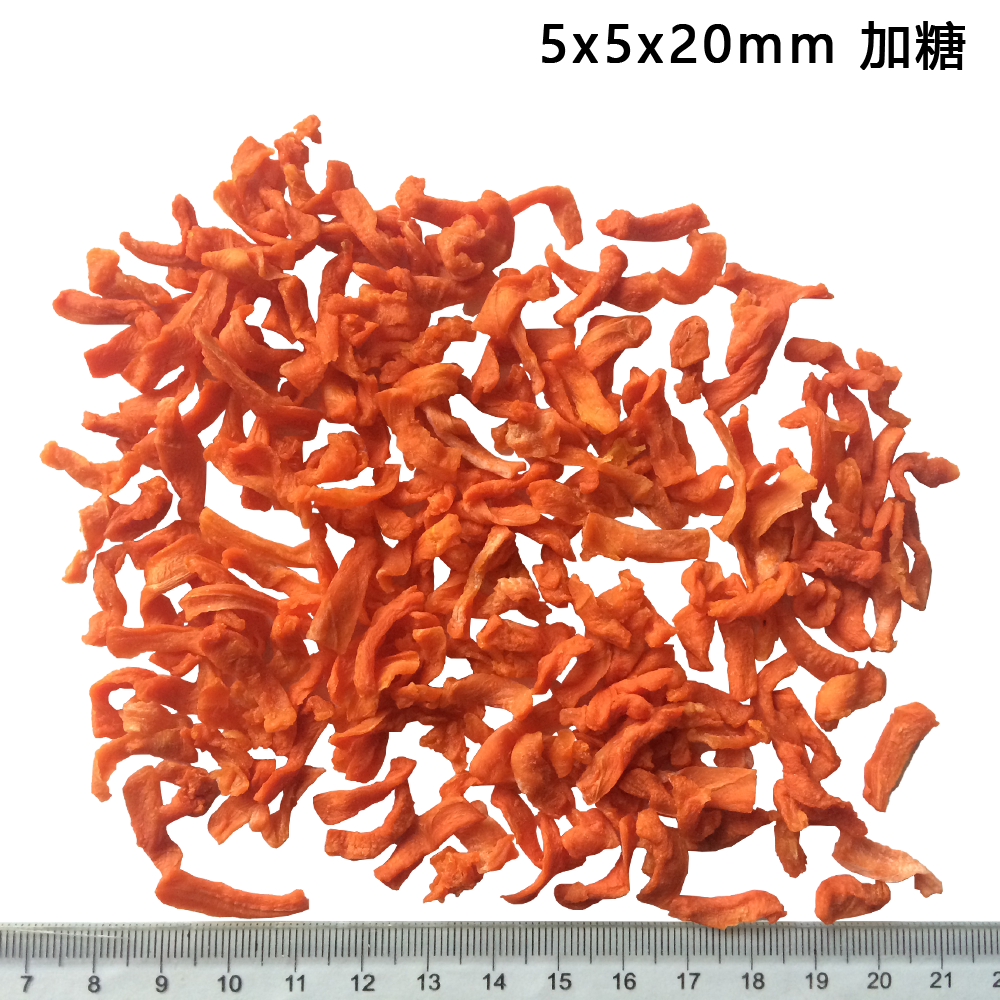
|Dehydrated carrots | Carrot granules, diced carrots, carrot powder | Japan, South Korea, European Union, North America | Low heavy metal risk, good rehydration, widely used as baby food and soup ingredients; Gansu and Shandong are the core production areas|
Note: The three together account for over 65% of China's total dehydrated vegetable exports and are the "ballast stones" for export earnings.
2、 High growth potential and emerging export varieties
Dehydrated onions: mainly in granular and flaky form, sold to the Middle East and Southeast Asia, used as curry and fast food ingredients; Jinxiang in Shandong and Xinghua in Jiangsu are concentrated production areas.
Dehydrated spinach: mainly using freeze-drying (FD) technology, exported to high-end supermarkets in Japan and South Korea, used as a nutritional enhancer in baby food and meal replacement powder.
Dehydrated corn kernels: Cold drying process, exported to North America and Europe, used for salads and ready to eat meals, with an annual demand increase of over 15%.
Dehydrated pumpkin strips: an emerging category that will be exported in bulk to South Korea for the first time in 2026, with a focus on the concept of low calorie healthy snacks.
3、 Export market preferences and access requirements
|Target market | Preferred varieties | Key entry thresholds|
|Japan | Freeze dried scallions, dehydrated spinach, carrot seeds | Pesticide residue limits are stricter than Chinese national standards, requiring no sulfur fumigation and no preservatives|
|South Korea | Dehydrated garlic, chili flakes, onion granules | HACCP certification required, packaging labeled as "non GMO" and "no additives"|
|EU | Carrot diced, dehydrated onion powder | Cadmium ≤ 0.05 mg/kg (stricter than GB 2762), sulfur dioxide color protection is prohibited|
|US | Chili flakes, dehydrated garlic powder, pumpkin strips | FDA registration required, labels comply with FDA 21 CFR Part 101|
|Middle East | Dehydrated chili, onion, garlic | Emphasize spice concentration, accept traditional packaging, require halal certification|
4、 Industrial support and export mode
Main production areas: Linyi in Shandong, Zhoukou in Henan, Gaotai in Gansu, and Xinghua in Jiangsu have formed an "industrial cluster+standard base" model.
Certification system: 90% of export enterprises have passed HACCP, ISO 22000, and BRC certifications, and 100% of exported products have achieved blockchain traceability.
Customs clearance efficiency: With the support of the customs' "cloud issuance" system, the processing time for plant quarantine certificates and health certificates has been shortened from 2 days to within 10 minutes.
Technological upgrade: The export proportion of freeze-drying (FD) process exceeds 40%, and the average price is more than 5 times that of hot air drying (AD) products.
Note: The above varieties strictly comply with the standards of NY/T 1045-2025 and GB 2763-2026, and the exported products simultaneously meet the regulatory requirements of the target country, achieving both national and international standards.
Data sources: General Administration of Customs, Ministry of Agriculture and Rural Affairs, China Chamber of Commerce for Import and Export of Food, Soil and Livestock, as of April 2026.